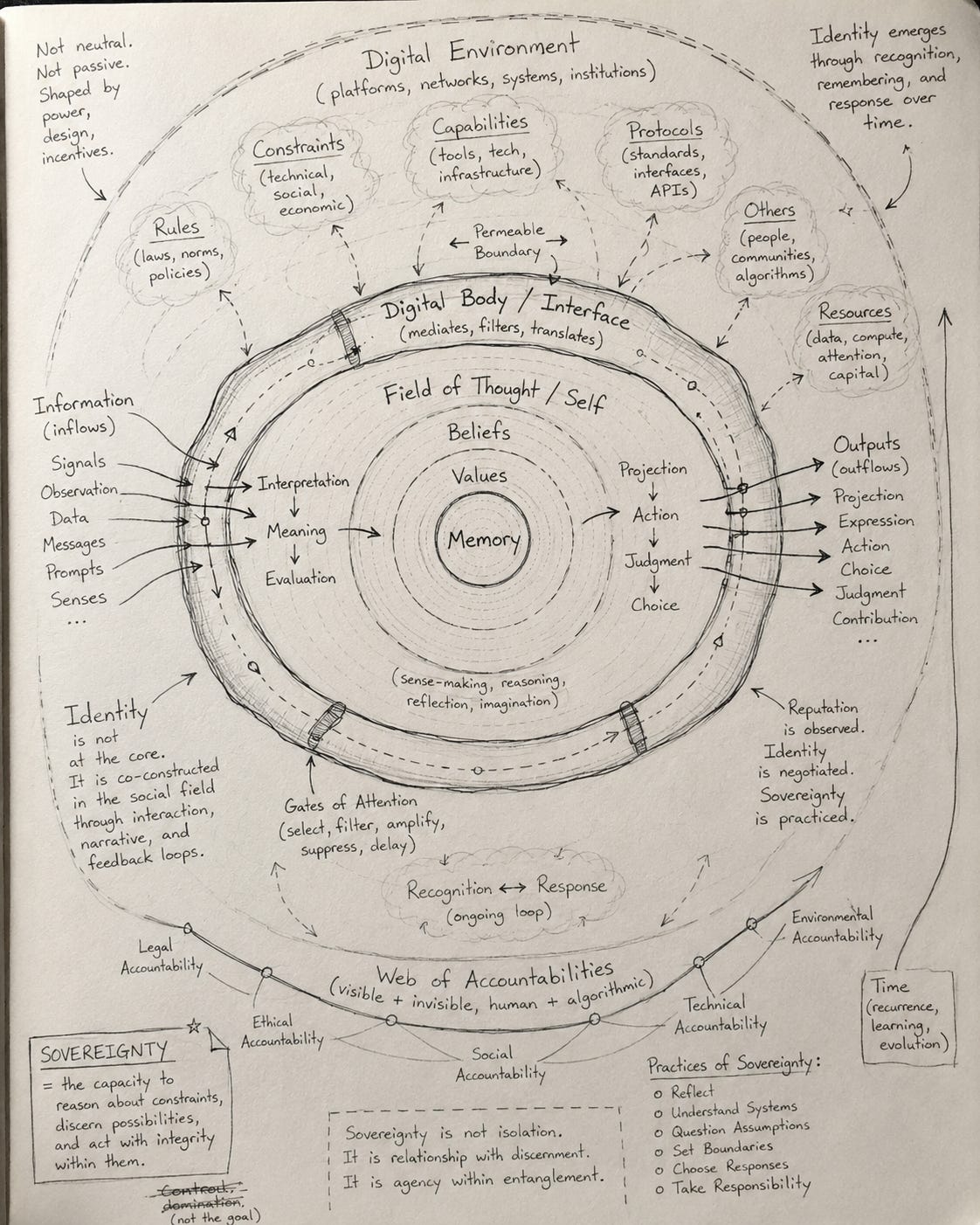
Sovereignty over our Digital Selves
Exploring sovereignty, freedom and the meaning of self-sovereign identity

These words were inspired by reading On Freedom by Timothy Snyder and participating in the discussion around the revised principles of SSI. The intention is to present an alternative, thought-provoking frame to think through identity and sovereignty in digital environments. Enjoy :)
What do we actually mean by Self-Sovereign Identity (SSI)?
Why is it so important to design systems that follow the principles of SSI?
One framing I have found useful recently is sovereignty over our digital selves.
That is, the principles of SSI are really principles for designing systems that enable and empower individuals to be sovereign over their digital selves.
This framing redirects our attention away from identity and towards sovereignty and the digital self.
Of course this raises questions: What is sovereignty? What is a digital self? Where are our digital bodies?
Let me try and address them in turn.
What is sovereignty and what does it mean to be sovereign?
Sovereignty is our ability to reason about the world and our capabilities and constraints for action within it. It is our ability to perceive and explore possibilities, to select actions from within this possibility space using values-based judgments with an orientation towards the future. And in doing so learn more about ourselves and the world we inhabit.
Human sovereignty is located in the living human body, the interface that mediates the self’s subjective experience of external reality. It is through this mediated experience we are brought into relation with our environment and the other beings that inhabit it. The body helps us recognise and acknowledge our shared existence as we try to see the world and ourselves through the eyes of others.
It is through the body that we discover, explore and struggle against the constraints of our environment and our capacity for action within it. Over time becoming increasingly capable, increasingly sovereign, increasingly free.
However, we can all recognise that nobody is born free, sovereign or capable. Rather, we are utterly dependent on the care, love and attention of others to raise us as capable, sovereign individuals. To teach us our capabilities and help us understand our limitations. To introduce us to and help us orient ourselves within a world of values.
While the body mediates our experience of reality, it is our memories that place us in time and uniquely locate us within a world of values. In doing so, both the past and the future are made present, colouring and structuring our experience and the possibilities we perceive and judge for action within the present.
We have all been sculpted by different pasts, both those we have lived experience of and those we find ourselves socially situated within. These threads and roots into our past show up unpredictably, providing a frame of reference through which we make sense of the present and chart pathways towards desired futures.
To be sovereign does not mean to be free from all constraints and responsibilities over the activities one engages in. Rather, it is to be entangled, and to entangle others, in a web of accountabilities that regulate and coordinate shared activity.
To be sovereign is to be capable of reasoning about the activities we engage in, the accountabilities they entangle and the anticipated futures they may bring about.
When we think with values, we are drawing from the past, but we are not stuck in it. We are considering the present, but we are not sanctifying it. We are oriented toward the future, and we are making it.
On Freedom, Timothy Snyder
Why is sovereignty an important property?
Sovereignty is important if we want to live in freedom and participate in free, lively, dynamic societies that are open to possibility, change and the unpredictability of the future. It is the foundation upon which freedom is built and sustained.
Sovereign individuals capable of making informed, values-based decisions from their own unique vantage point animate and enliven free societies. Societies in which individuals are not free from constraints, but free to reason about constraints and how to use them to their advantage. Societies where individuals are free to live their lives according to the values they judge important at any given moment and pursue the futures they find meaningful. Sovereign individuals are capable of this.
It is the unpredictable actions of sovereign individuals that drive change in our world.
A free society is a society that recognises the value of values and the creative potential these differences in values generates.
Societies that raise sovereign individuals open themselves and their futures to possibility. To the discovery of new values to live by and new capabilities to act through. They acknowledge the inherent unpredictability of the future and raise individuals capable of navigating these waters, trusting them to go out into the world and chart their own course.
The alternative is societies that close themselves off to the future by denying its unpredictability and limiting its potential. Such societies are distrustful of unpredictable, sovereign individuals preferring instead to render individuals as predictable objects to be nudged and corralled into ever more probable states. Controllable, conformant individuals, that no longer think for themselves, no longer take responsibility for their actions and the futures they bring about.
This leads to a deadening of our world. A flattening of our possibility space. A hollowing out of meaning.
I know which world I would rather live in.
We must resist the desire of others to make us more predictable.
We must resist the temptation to render others we meet as predictable objects.
Instead, let us aspire to inhabit our own rugged borderland of unpredictability1 and create invitations and pathways for others to step into theirs.
Let us help and encourage each other to be increasingly sovereign over our selves.
What is a digital self?
First, what is a self?
Without attempting any kind of scientific definition here. A self is something that animates a body inhabiting an environment. The body mediates the self’s experience of external reality. A self is the internal processes of life. A self simulates and understands itself, its identity, its environment and the other embodied selves it encounters within it. A self attempts to make sense of reality. A self enacts this reality, imbuing it with ever shifting worlds of meanings.
A self is the fuzzy, undefinable process that is capable of becoming sovereign over the body they inhabit and the space-time-value continuum they navigate.
A digital self is a self that inhabits digital environments. That attempts to make sense of these digital environments and the constraints and capabilities for action within it.
Digital environments do not have the same rules and laws as physical ones. But they are environments and we do inhabit them all the same.
Our physical devices create portals that displace us from our bodies and transport us into digital realms.
We are not native to these worlds. We arrive into them as naked and helpless as a newborn baby.
However, in these worlds there is no one to mother us. No one to protect, nurture and care for us. No one to teach us how to navigate this hostile, alien environment. No one to help us grow into digitally sovereign, capable individuals.
Instead, it is the wild west and we are expected to fend for ourselves.
We find ourselves in a situation akin to lab rats with our experimenters given godlike powers over the properties and rules of our environment. Through their experiments they seek to understand us, to predictify us and to control us.
Digital identity systems, all too often are systems given to us by those same experimenters seeking to track and render our behaviour in ever greater fidelity.
And while the digital worlds are distinct from our physical reality, they are deeply entangled. It is disembodied humans that animate digital selves. Embodied humans moving through space, time and among values.
The predictification2 of our selves in digital environments reverberates through these other dimensions. Our sovereignty over our human bodies is compromised. No longer are we unpredictable, richly textured, embodied living beings pursuing our own values and dreams of futures but flattened predictable objects dancing to someone else’s tune.
Where are our digital bodies?
So far I have argued that selves can become sovereign over their bodies and through their bodies their mediated capability for action in the world.
If we accept that our selves inhabit digital environments and move through digital worlds, one question that arises is this: where is the body that separates the internal digital self from its external digital reality. The interface that mediates the self’s experience of the digital realm. The vessel that constrains and enables the self’s capacity for action in digital worlds.
Why is this a useful frame?
It helps us recognise what we do not have today, while also drawing attention to the fundamental limitations and differences of digital worlds and the bodies that can inhabit them.
These are artificial environments that operate under different, often opaque rules.
A digital body is not a human body.
While digital bodies are primarily animated by human selves, such bodies are not restricted in the way human bodies are.
We all know and have deep experience of the fact that our physical bodies are our own.
Only one self controls and can be held accountable for the actions of a human body. Although many may and do attempt to influence and control the self, the meanings it makes of the world and the actions it takes.
An embodied human moving through space and time has the capacity to make sense of its environment and the other beings it encounters within it. The physical environment and the capabilities of others within it can be reasoned about with a degree of confidence. With the reasonable expectation that these properties will persist in the future.
The reality of digital realms and activities mediated across digital technologies is that we can never know with certainty the human being animating this activity. This is the uncanny gap that separates physical and digital realities. The uncertainty that can never wholly be overcome.
This is a constraint that we would do well to understand and work with, rather than ignore or convince ourselves that it does not exist.
I do not have all the answers here. I am just suggesting that the analogy of a digital body may provide a different, interesting lens to think through these challenges.
It implies that there is some private, inviolable internal realm and a border across which the experience of a digital reality is mediated. It suggests that the body should be capable of moving as a constancy through time and in digital space. Bodies can be observed, but they can also often know and reason about who or what is observing them. Embodied selves can act with the intention of effecting change in the world and can reason about the affects their actions may have on themselves and others.
Identities are applied to bodies as they are observed over time, layering on meanings through which an identified body’s actions are interpreted and understood. In digital worlds, the system is both the environment we inhabit and an observer of our interactions. These systems cannot give us identity, but they do form their own understandings of us, and if we are not careful, these can become the dominant identities through which we understand ourselves.
The other aspect of digital bodies I find to be thought provoking is what constrains its capacity for action. Today, in the majority of environments and systems in which “users” act, the constraints over these actions are arbitrary and unevenly enforced at the whims of those with asymmetric power over the environment and the users that it graciously allows access to. These are environments that do not support the application of reason.
The capabilities of bodies are defined by their constraints within an environment. Constraints that can be discovered, used and struggled against. Constraints that are enforced consistently and unfeelingly, without caveats or exception.
What if digital environments exhibited these properties?
I want to inhabit digital worlds whose environments are composed of substrates whose rules are knowable, can be reasoned about and can be struggled against. Can be challenged and changed. With the possibility for change itself, something that can be subject to reason.
We need a new physics for these digital worlds, one in which cryptography provides the atomic building blocks upon which digital facts can be established and digital truth is grounded.
What if instead of focusing on how we design identity, we focus on designing the conditions for individuals to become increasingly sovereign over their digital selves? Identity is what emerges from the interactions of these selves across space, time and among values. It is the name we give for the sense an observer makes of a self. It is not something that can be designed, issued or provided.
Instead, we should focus on designing systems that empower individuals with the capabilities to show up in digital environments as a constancy, make sense of that environment, the rules under which it operates and the others that we encounter within it.
Individuals capable of being sovereign over their digital selves.
Predictification is a great word that Snyder uses to describe the state when we let our machines define us by our most probable states. They predictify us.
This is a beautiful phrase used throughout Timothy Snyder’s On Freedom. The individually perceived and inhabited human space between what is and what should be. This is the zone of freedom.