

Written after developing a proof of concept for Tree Appreciation and reflecting on insights from the Regenerative Futures symposium in Coventry. I am grateful for the perspectives, language and wisdom shared. Originally published at https://futurewip.com/tree-appreciation
Over the last year, I have developed a richer, deeper appreciation of trees. I have always loved them, but never fully acknowledged or attended to that love.
And like all things, the more you focus on them the more you notice. The more they seem to give.
Tree Appreciation as an idea, started at the Global Digital Collaboration conference in Geneva last summer. I was in a jolly old mood back then. Still riding high after an epic weekend at Glastonbury. The trees of Geneva just seemed so beautiful. My mind was attuned to them. I appreciated them.
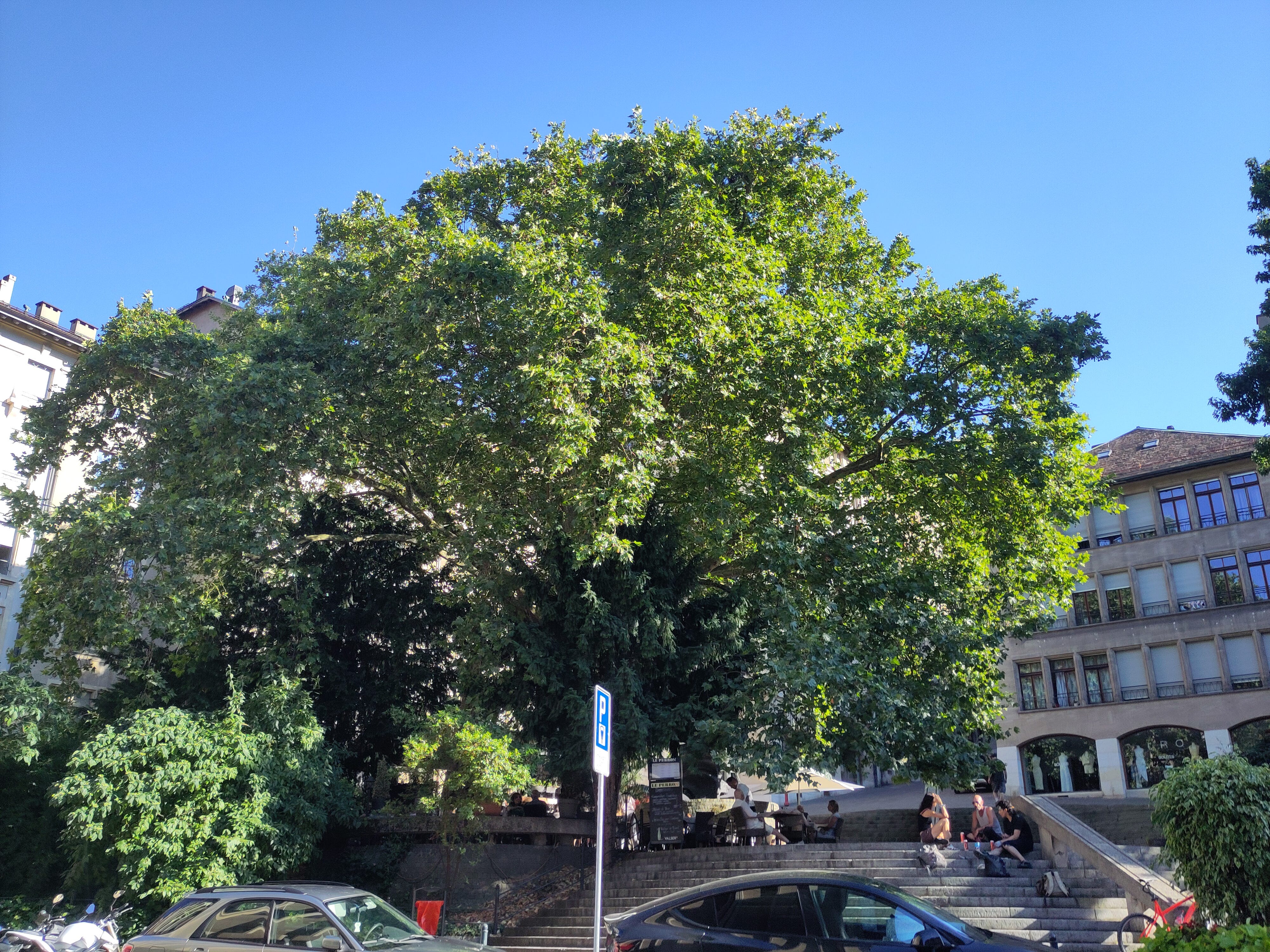
So much so in fact at the end of the conference I persuaded some friends and colleagues to join me on a tree appreciation walk. Highly recommend it as an a conference activity - or any kind of activity, really.
This prompted me to buy treeappreciation.com and treeappreciationwalks.com. Placeholders that I would someday, do something with.
It also led to the creation of a Tree Appreciation WhatsApp group, which has been fun, friendly space to share appreciation for the trees we encounter in our lives. Feel free to join if you want.
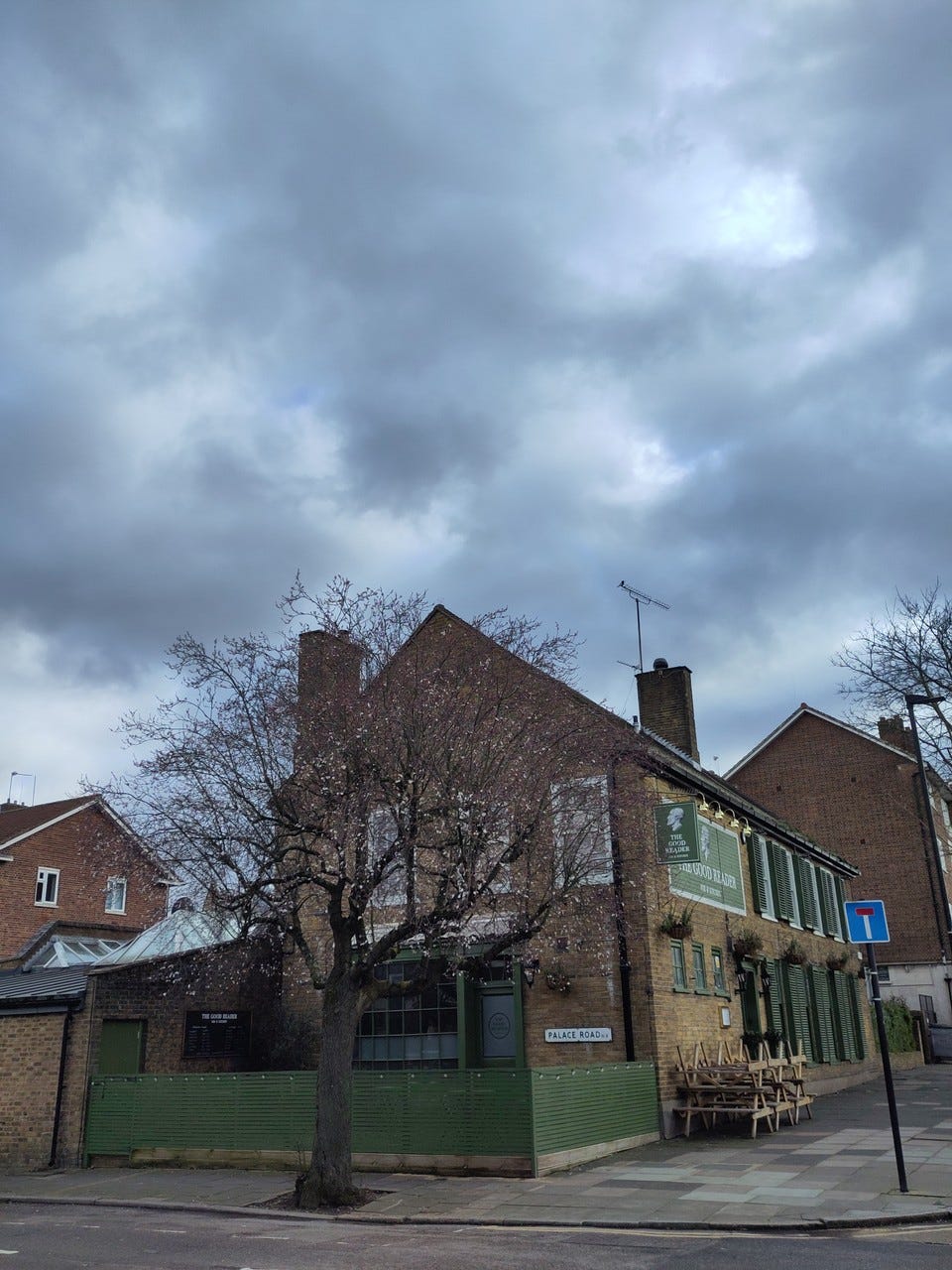
I’m looking forward to the blossoming of spring. It’s coming!
Anyway, all this is to provide some context and history for how things got to this point.
Why Trees?
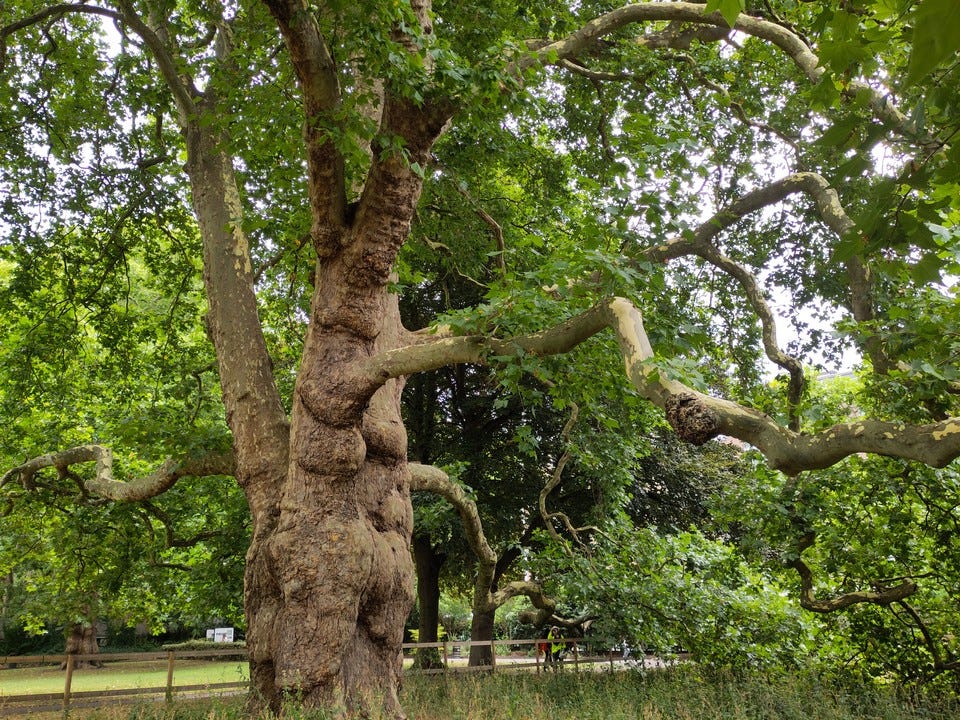
Trees are ideal anchors for both memory and meaning-making rituals. They provide a point of continuity across generations, while visibly expressing the cyclical nature of time through the seasons: Dormancy, renewal, growth, and transformation. An ever present reminder of the constancy of change.
Trees are local. They are located in one place, almost always continuously throughout their life times. Though, while rooted in place, they are far from alone. Through its roots, bark, and leafy canopy, the tree participates in layered ecologies that stretch from subterranean fungal networks to the migratory paths of birds. Trees are deeply connected and present in the locality they inhabit.
Trees are sacred. They carry deep cultural resonance throughout history and across cultures. We are instinctively drawn to them. They provide food, shelter, cooling shade and quietly invite us to gather, rest and reflect.
Although lately, in our busy, hyperconnected world, how many of us have taken up this invitation? Or even noticed it was being offered?
Designing Tree Appreciation
Now let me talk you through my latest thinking about Tree Appreciation, as an idea, a project and a possibility.
I have tentatively breathed life into treeappreciation.com. It exists. Has life. Is alive.
For me, this is in the same family of ideas as life of books and viewing time and orbits my thinking on memory and meaning. It is also very much aligned, or adjacent to, the explorations of intercultural roots and EcoGPX into place-based technologies.
The question I have been noodling around, is how can we create lasting presences for the trees around us. How can they act as anchors for our memories. Our experiences. How can we celebrate their lives and the interconnected web of relationships that sustains them and in turn ourselves.
I want to give real trees, geographically rooted within one physical location a digital presence. A lovingly curated, cared for digital presence. I wonder what such a digital presence might enable. What new ways of acknowledging, appreciating and relating to the natural world.
I also wonder how it might shape how trees relate to us and indeed to each other.
Digitally augmented trees. A new social media for trees. Tree intelligences.
What stories and words of wisdom might they share if we only knew how to listen.
In my more speculative moments, I imagine how language models might give voices to trees and what it might mean if they could speak. This is not as far fetched as it might first seem. Projects like Project CETI are exploring interspecies communication with whales, while Nature Perspectives is experimenting with representing ecological viewpoints.
I have experimented with several technical frameworks to realise an initial proof of concept.
I first looked at Ethereum, intending to mint an NFT for each tree. First using the MUD framework, then Scaffold-ETH. Great technology, but the design patterns never felt quite right.
I wanted the state of this application to live beyond and single server or platform. I draw inspiration from autonomous worlds and want to build a systems that provide public verifiability while inviting open permissionless participation.
However, I am not a fan of the inevitable financialization of NFTs invite. Nor do I love the burden of key management that every contributor would have to navigate.
I wanted this to be something my mum could use. Maybe even my gran.
Recently, I attended a Protocols for Publishers conference - cool stuff - where I got some more exposure to Bluesky, AT Proto and decentralized social media. A great talk from Laurens Hof really helped to crystallize the framework and its potential in my mind.
I decided to dive into the tooling and hack something together. I liked the simplicity of it.
No deployment complexity. It just seemed to work.
I designed my own lexicons (data objects), used the Bluesky Personal Data Store for data storage and account management. Bluesky uses did:plc identifiers for accounts. Actions are signed with keys controlled by the account, although managed centrally, offering a step toward decentralization while sidestepping the usability challenges of self-managed keys.
My hope would be that one day Bluesky enables and supports people to bring their own DIDs.
Anyway. That is getting bogged down in the technicalities, which is always tempting and often distracting.
Point is I got something working.
The basic flow. Something tangible.
Anyone can go on treeappreciation.com and view the presences of trees currently seeded and rooted in this decentralized protocol. Anyone can create an account, with an accompanying did:plc, at Bluesky and use that account to seed trees of their own.
You can also inscribe into the memory of trees that already have presence. Recording new moments and meanings shared with this tree.
The question I have now, is what next?
What is the point and purpose of this application?
What are the rituals and patterns of embodied behaviour I am hoping to induce?
From User Experience to Embodied Experience
Last week I attended a wonderful symposium on regenerative futures co-organised by DAO CreaTech and Intercultural Roots. It was a delightfully analogue affair for the most part. A flowing conversation, sitting around a circle, listening, learning, contributing and connecting. It was humbling to be part of such a richly textured dialogue, with so many valuable perspectives shared. All too rare these days.
Intercultural roots is a network of creative practitioners and researchers focused on using art for social change. This network has nurtured and resourced a constellation of fascinating projects exploring how to weave arts and technology together to create and strengthen community-led culture.
These include:
EcoGPX places: A mobile app where creative media is placed at a spatiotemporal location and discoverable through a proximity algorithm.
DAO CreaTech: An innovate UK funded project developing a platform and suite of tools for communities to crowdfund and co-organise cultural events drawing on ideas from decentralized autonomous organizations.
eXtending Nature: An innovate UK funded project exploring how the places app could act as a doorway connecting people to mindful, ecosomatic practices delivering place-based therapeutic support to combat anxiety.
There is a lot of synergy between my thinking on memory and that of the Intercultural Roots community, albeit approached from different background and perspectives. I am excited about both the intersections and differences in our thinking and look forward to our continued collaboration.
Here are some of the insights I took with me from this day.
We discussed the need to carefully challenge the deeply entrenched, sedimented layers of design practices, expectations and language when it comes to developing software applications. Many of us feel the uneasy tension of our current relationships to digital technology and its extractive, addictive, attention optimizing practices. It is the legacy of these approaches that shapes and constrains our perception of the possibility for app design, often without us even noticing.
We talked about the intentional design of the places app as a quiet companion and comforting guide, in stark contrast to the addictive logic of the attention economy. The need to constantly push back against feature creep and celebrate its elegant simplicity. Places is not meant to be a virtual space you spend time in, it does not want to maximize your time in the app. Rather its goal is to deepen your connection to the physical place you are present in, its history, stories and the webs of relationships that make up the more-than-human nature present in the space. To enrich your experience of the here and now.
This all rings true for Tree Appreciation. I want a application that you use as a stepping stone towards strengthening your connection to the natural world. Deepening your appreciation of the trees around you. Not an application that sucks you in to its 2D realm, renders you as a user and seeks to maximize your engagement.
Building on this we discussed moving from User Experience to Embodied Experience. Designing for the embodied experience of a human embedded in the natural world as they extend themselves through interaction with an application rather than the experience of clicks, swipes and taps as an abstract user navigates a 2D space.
In order to do this you need to understand the humans you are designing for and the worlds they are embedded within. Global scale applications pursuing exponential growth rarely meet the needs of a specific locale, community and context. Instead, it is vital to reach out, connect and listen deeply. Nurture relationships of care and reciprocity. Intercultural roots and the interconnected web of projects they have grown in Coventry is exemplary of this community-led approach to design.
This feels radical. A quiet reimagining of what design could be.
An Invitation
Let me close with an invitation.
This week, notice one tree you pass by. Stop for a moment. Give it your full attention.
Take in its bark, branches and the shape it makes against the sky. Imagine its past, the time that has already flowed beneath its canopy. Anticipate its futures, what it might yet become.
If you feel called, give it a name. Acknowledge its presence in your life, and in the web of life around it.
Make an intention to return. Soon. And when you do, watch for change: the first softening of buds, the first green hints, the blossoming of life. Spring arriving, quietly, without announcement.
Notice your appreciation bloom.